
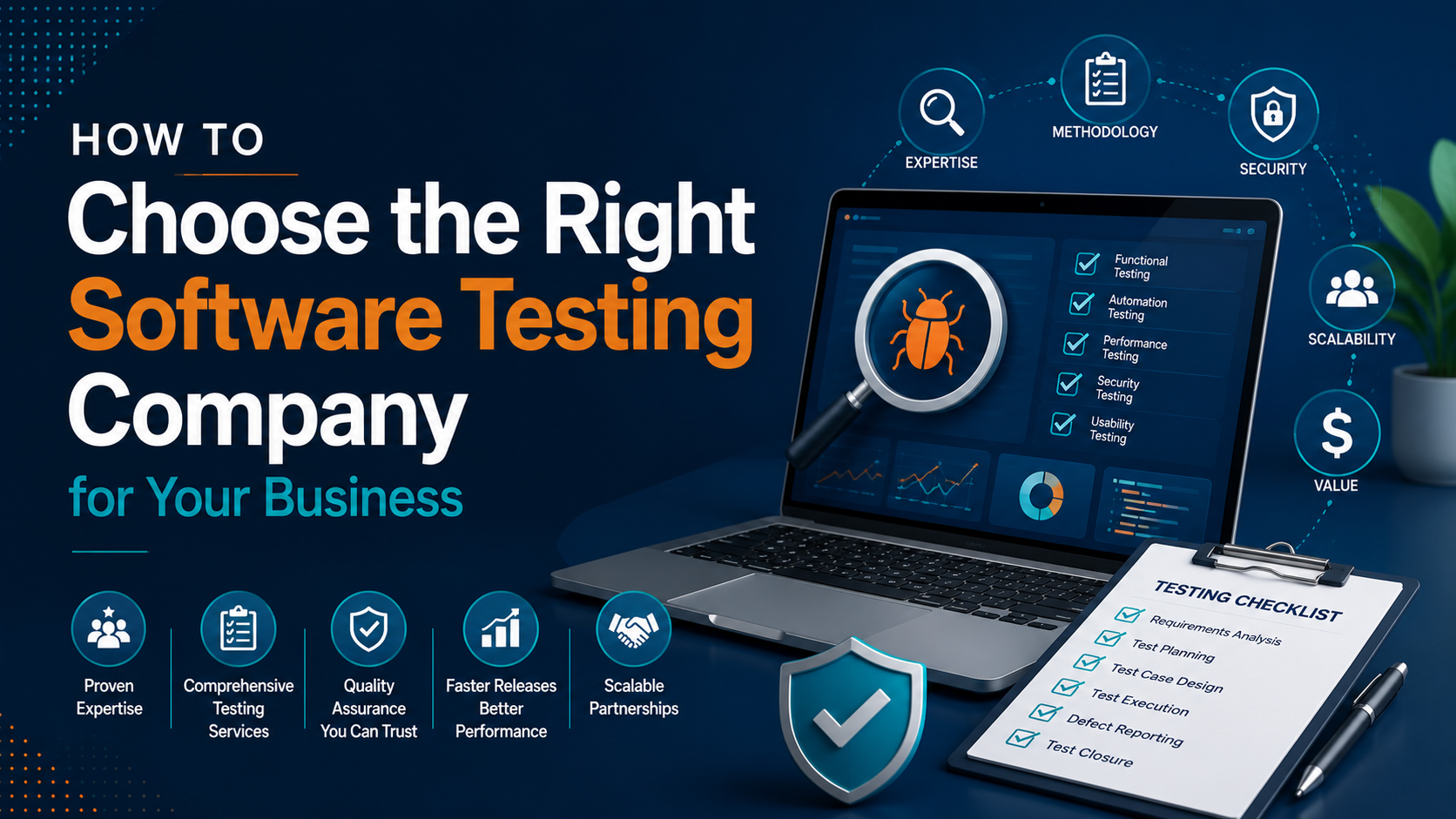
To choose the right software testing company, evaluate its technical expertise, testing capabilities, industry experience, automation skills, security practices, communication process, scalability, reporting standards, and engagement models. The best testing partner should understand your business requirements, integrate effectively with your development process, identify risks early, and help you release reliable software faster.
Introduction
Software quality can directly influence customer satisfaction, revenue, security, and brand reputation. Whether you’re developing a SaaS platform, mobile application, ecommerce website, enterprise system, or customer-facing digital product, defects can quickly turn into expensive business problems.
A failed payment process can result in abandoned purchases. A performance issue can drive users away. A security vulnerability can expose sensitive data. Even smaller usability problems can negatively affect customer experience.
This makes software testing an essential part of modern software development.
However, maintaining a complete in-house Quality Assurance (QA) team isn’t always practical. Organizations may need specialized automation engineers, performance testers, accessibility specialists, security expertise, or additional testing capacity during major releases.
Working with a professional software testing company can provide access to these capabilities without requiring businesses to build every testing function internally.
The challenge is choosing the right partner. Software testing companies vary considerably in expertise, methodologies, technology capabilities, pricing, and service quality.
This guide explains the most important factors businesses should evaluate when selecting a software testing company.
Why Choosing the Right Software Testing Company Matters
Testing isn’t simply about identifying bugs before release. An effective QA partner should help prevent defects, improve development processes, identify product risks, and increase confidence in every release.
Choosing the wrong testing provider may result in incomplete test coverage, communication delays, missed defects, unnecessary costs, and slower releases.
The right software testing company can help businesses achieve:
- Higher software quality
- Better test coverage
- Faster release cycles
- Fewer production defects
- Improved application security
- Better user experiences
- More efficient development teams
- Reduced QA operational costs
The relationship should therefore be viewed as a long-term quality partnership rather than simply outsourcing test execution.
Understand Your Software Testing Requirements First
Before comparing testing companies, define exactly what your organization needs.
Different projects require different combinations of testing expertise.
Identify the Application Type
Consider what you’re testing:
- Web applications
- Mobile applications
- SaaS products
- APIs
- Enterprise platforms
- Ecommerce websites
- Cloud applications
- Desktop software
A provider experienced with similar applications is more likely to understand the relevant risks and testing scenarios.
Determine the Testing Services Required
Your requirements may include:
- Functional testing
- Regression testing
- Test automation
- Performance testing
- Load testing
- API testing
- Mobile application testing
- Security testing
- Accessibility testing
- Compatibility testing
- User acceptance testing
Defining the scope before contacting providers makes comparisons significantly easier.
Key Factors to Consider When Choosing a Software Testing Company
1. Technical Expertise and Testing Capabilities
Technical capability should be one of your first evaluation criteria.
A reliable testing company should demonstrate expertise across multiple QA disciplines rather than relying entirely on basic manual testing.
Ask about experience with areas such as test automation, API validation, mobile testing, performance engineering, accessibility, and security.
A broader skill set becomes especially valuable as applications grow more complex.
2. Relevant Industry Experience
Industry knowledge can significantly improve testing effectiveness.
For example, ecommerce applications require careful validation of shopping carts, payment gateways, product searches, and checkout flows. Financial applications may require greater emphasis on security, data integrity, and regulatory requirements.
Evaluate whether the provider has experience with projects similar to yours.
Relevant industry experience helps QA teams identify high-risk scenarios faster and understand how customers actually use the product.
3. Software Testing Methodology
Ask potential providers to explain their testing process.
A mature QA methodology typically includes:
- Requirement analysis
- Test planning
- Test case development
- Test environment preparation
- Test execution
- Defect management
- Regression testing
- Reporting
- Test closure
The company should also be comfortable working within Agile, DevOps, and continuous delivery environments when required.
Evaluate Test Automation Capabilities
Automation has become an important component of modern software testing, particularly for products that release frequently.
Ask how the company determines which test cases should be automated rather than simply asking whether it offers automation.
Experienced teams typically prioritize repetitive and high-value scenarios such as:
- Regression tests
- API tests
- Cross-browser validation
- Repetitive workflows
- Critical business transactions
They should also understand how automated tests can be integrated into CI/CD pipelines.
Automation should improve testing efficiency and release confidence rather than becoming an objective by itself.
Check Their Testing Tools and Technology Expertise
A software testing partner should be comfortable with modern QA technologies.
Depending on the project, this could include experience with tools and frameworks such as:
- Selenium
- Playwright
- Cypress
- Appium
- Postman
- JMeter
- Jenkins
- GitHub Actions
- Jira
Don’t select a provider solely because it uses a particular tool. Focus on whether the team can select and implement technologies appropriate for your architecture, development environment, and business requirements.
Assess Security and Data Protection Practices
External testing teams may access source code, test environments, credentials, customer information, or other sensitive business data.
Security practices therefore deserve careful evaluation.
Ask how the provider manages:
- Data confidentiality
- Access permissions
- Test credentials
- Secure environments
- Employee access
- Confidential information
- Data retention
- Non-disclosure agreements
Businesses operating in regulated industries should also determine whether the provider can support applicable security and compliance requirements.
Look at Communication and Collaboration
Technical expertise alone doesn’t guarantee a successful testing partnership.
Your QA team must communicate effectively with developers, product managers, project managers, and other stakeholders.
Evaluate:
- Communication channels
- Meeting frequency
- Escalation procedures
- Time-zone coverage
- Project management practices
- Response times
A good testing company should operate as an extension of your development organization rather than functioning as an isolated external team.
Review Defect Reporting and QA Metrics
Clear reporting helps stakeholders understand product quality and make informed release decisions.
Ask prospective partners to provide sample testing reports.
Useful QA metrics may include:
- Tests executed
- Pass/fail percentage
- Defects identified
- Defect severity
- Defect leakage
- Regression status
- Test coverage
- Automation coverage
Reports should provide actionable insights rather than simply presenting large amounts of data.
Consider Scalability and Resource Flexibility
Testing requirements often fluctuate throughout a project’s lifecycle.
You may need a small QA team during regular development and additional specialists before a major product launch.
Evaluate whether the provider can:
- Increase testing resources quickly
- Reduce resources when necessary
- Provide specialized QA engineers
- Support multiple projects
- Handle changing release schedules
Scalability is particularly important for startups and rapidly growing software companies.
Compare Engagement and Pricing Models
Software testing companies commonly provide several engagement options.
Dedicated QA Team
A dedicated team works continuously with your development organization and is suitable for long-term products requiring ongoing testing.
Project-Based Testing
The provider handles a defined testing project with an agreed scope and timeline.
Managed Testing Services
The testing company manages a larger portion of the QA function, including planning, execution, reporting, and continuous improvement.
On-Demand Testing
Additional testers or specialists are provided when required.
Pricing should be considered alongside expertise, service quality, flexibility, and expected business value. The lowest-cost provider is not necessarily the most cost-effective option if inadequate testing results in production failures.
Ask for Case Studies and References
Before making a decision, look for evidence of previous work.
Relevant case studies can demonstrate the provider’s experience solving challenges such as:
- Reducing regression testing time
- Increasing automation coverage
- Improving release frequency
- Detecting performance bottlenecks
- Improving product quality
- Supporting complex application migrations
When possible, look for results from businesses with similar applications, technologies, or industries.
Red Flags to Watch for When Selecting a Testing Company
Certain warning signs deserve additional scrutiny:
- Promising 100% defect-free software
- Providing estimates without understanding requirements
- No documented testing methodology
- Limited reporting transparency
- Heavy dependence on a single testing approach
- Poor communication during initial discussions
- No clear data security practices
- Unable to provide relevant project examples
- Recommending automation for everything
- Extremely low pricing without explaining resource quality
A professional testing company should be realistic about software risks and transparent about how it plans to address them.
Questions to Ask a Software Testing Company
Before selecting a provider, consider asking:
- What types of applications do you typically test?
- What testing services do you specialize in?
- How do you create a test strategy for a new project?
- How do you decide which tests to automate?
- Which automation frameworks do you support?
- How do you report and prioritize defects?
- How do your testers collaborate with development teams?
- How do you protect confidential data?
- Can your team scale during major releases?
- What metrics do you use to measure testing effectiveness?
- Can you provide relevant case studies?
- What does your onboarding process look like?
The answers can reveal far more about a potential partner than pricing alone.
In-House Testing vs Outsourced Software Testing
| Factor | In-House QA | Outsourced Testing |
|---|---|---|
| Initial hiring effort | Higher | Lower |
| Access to specialists | Depends on team | Usually broader |
| Scalability | More difficult | More flexible |
| Internal product knowledge | High | Requires onboarding |
| Infrastructure costs | Internal responsibility | May be shared |
| Resource management | Internal | Provider-supported |
| Best suited for | Stable long-term requirements | Flexible or specialized requirements |
Neither approach is universally better. Many organizations use a hybrid model where internal QA professionals maintain product knowledge while external specialists provide additional capacity or expertise.
Frequently Asked Questions
What should I look for in a software testing company?
Look for technical expertise, relevant industry experience, strong testing methodologies, automation capabilities, transparent reporting, security practices, scalability, and effective communication.
How do I compare software testing companies?
Start with your requirements and compare providers based on relevant experience, QA capabilities, team expertise, processes, technology, engagement flexibility, case studies, and pricing.
Should I choose a testing company based on price?
Price is important, but it shouldn’t be the primary selection criterion. Poor testing can create far greater costs through production defects, customer dissatisfaction, downtime, and rework.
Is outsourced software testing suitable for startups?
Yes. Outsourcing can help startups access experienced QA professionals and specialized testing skills without building a large internal testing department.
What testing services should a QA company provide?
Depending on your needs, services may include functional, regression, automation, API, mobile, performance, security, accessibility, compatibility, and user acceptance testing.
How can I evaluate a software testing company before signing a long-term contract?
Consider beginning with a defined pilot project. Evaluate test quality, defect reporting, communication, technical expertise, delivery consistency, and collaboration before expanding the engagement.
Conclusion
Choosing the right software testing company requires more than comparing service lists and hourly rates. The goal is to find a QA partner that understands your product, technology, customers, development processes, and business risks.
Start by defining your testing requirements. Then evaluate potential providers based on technical capabilities, industry experience, automation expertise, security practices, reporting, communication, scalability, and proven results.
Most importantly, consider how well the testing company can integrate with your existing development workflow. Effective software testing is collaborative. Developers, testers, product teams, and business stakeholders must work together to identify risks early and continuously improve product quality.
A carefully selected software testing partner can help reduce production defects, improve release confidence, accelerate development cycles, and ultimately deliver a better experience to your customers.